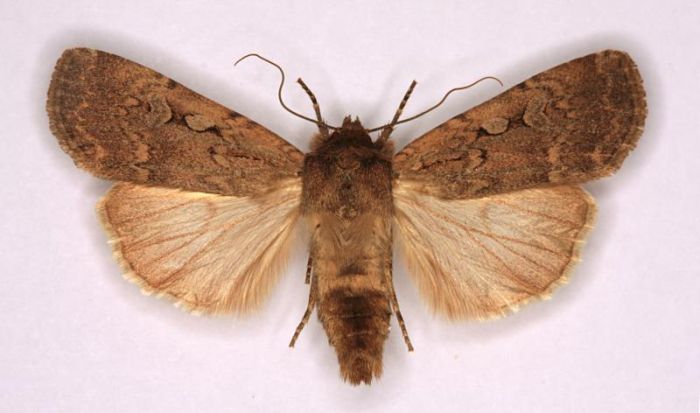
Photo © Mike Wall
Stout Dart
Spaelotis ravida
Checklist Number73.349 [B&F: 2113]
Verification
Record will require further evidence, at least a good photograph, unless CMR is aware recorder has confidence in identification
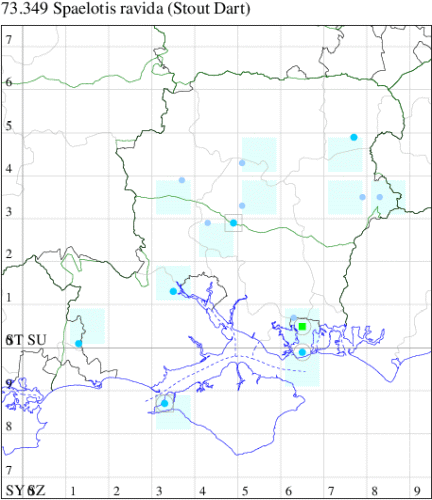
Local in damp grassland, meadows and marshes, in England, with great variations in abundance and temporary extensions of range; on the east coast the species is possibly reinforced by immigration. Recorded in the UK very infrequently in recent years and on the Red Data list. In Hampshire historically always very local but widespread, particularly in the centre of the county north of Winchester but scattered widely elsewhere. The map highlights all known historic records listed in the three county atlases (up to 2000), and there is only one report after the publication of these, of one to light in Cosham in 2001: while this is included for completeness, in the absence of confirming evidence this is unlikely to stand up to scrutiny. Before this, the last confirmed sighting in the county was in John Langmaid's Southsea trap in 1987, which itself may have been a migrant. The year before, August 1986, saw the Isle of Wight's sole record, at Freshwater, which would almost certainly have been a continental example. It was therefore likely on the brink of extinction in our area by the mid 1980s and is certainly no longer present. Wingspan 42-50 mm. Double Dart Graphiphora augur has no streak connecting the stigmata and the hindwing is wholly dark brown; Northern Rustic Standfussiana lucernea, which would normally be found in a very different habitat, also lacks this streak, has barely visible stigmata, and much darker brown hindwing; Garden Dart Euxoa nigricans is smaller and darker, with hindwing more suffused in both sexes (MBGBI Vol 9). Larva feeds on Sow-thistle, Dandelion and Dock.
The abundance in each month is indicated as follows:
 No records
 Very occasional
 Irregular
 Uncommon
 Off-peak, but not unusual
 Off-peak, but not unusual
 Main flight time
| J | F | M | A | M | J | J | A | S | O | N | D | |
|---|---|---|---|---|---|---|---|---|---|---|---|---|
| Adult | | | | | | | | | | | | |
| Larval | | | | | | | | | | | | |
Records by week (adult)
Records by week (larval)
VC10 Isle of Wight
| Site | Date | Quantity | Recorder | Stage |
|---|---|---|---|---|
| Freshwater (SZ38) | 20/08/1986 | one | Sam Knill-Jones | Adult |
VC11 South Hampshire
| Site | Date | Quantity | Recorder | Stage |
|---|---|---|---|---|
| Leckford (SU33) | 1945 | - | D H Sterling | - |
| Winchester College (SU42) | 1984 | - | Anon | - |
| Southsea (SZ69) | 27/09/1987 | one | John R Langmaid | Adult |
| Cosham (SU60) | 06/09/2001 | one | Terry Jennings | Adult |
VC12 North Hampshire
| Site | Date | Quantity | Recorder | Stage |
|---|---|---|---|---|
| Leckford Estate (SU33) | 1945 | - | Anon | - |
| Odiham (SU74) | 1983 | - | Mick Scott | Adult |