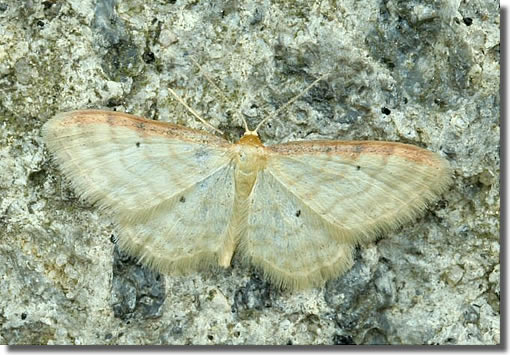
Photo © David G Green
Isle of Wight Wave
Idaea humiliata
Checklist Number70.007 [B&F: 1706]
Verification
Record will require further evidence, at least a good photograph, unless CMR is aware recorder has confidence in identification
Classification
| Family: | Geometridae |
| Subfamily: | Sterrhinae |
| Genus: | Idaea |
| Species: | humiliata |
| Authority: | (Hufnagel, 1767) |
A widespread species, ranging from north Africa across Europe (including Scandinavia) to Western Asia (through to Turkey and the Caucasus). Bretherton (1951, Ent Gaz 2: 233-4) gave an account of the history of this moth on the Isle of Wight, where it was discovered in the early 1890s at its only known locality was along the precipitous cliffs to the west of Freshwater, and needing 'peculiar weather conditions to bring it in reach of the entomologist's net'. It was taken from time to time in greater or lesser numbers and again in some quantity in 1931; in Hampshire, one was taken in Portsmouth in 1954 by R.Hayward (Proc.S.Lond., 1960). Attempts to re-discover this species on the Isle of Wight have always failed, but the isolated record from Hampshire gave hope that it may still lurk somewhere in the area; the passing of time would suggest that this colony, which may only have been transient in nature, is now extinct. Wingspan 19-22 mm. Records of this species will not be accepted unless the specimen is retained for examination, and care needs to be taken to eliminate the very much more common Dwarf Cream Wave I. fuscovenosa; in Isle of Wight Wave the costal streak is reddish-brown and it lacks the series of short dashes along termen of both hind- and fore-wings of Dwarf Cream Wave. Larva feeds on various herbaceous plants, including Common Restharrow and Germander Speedwell.
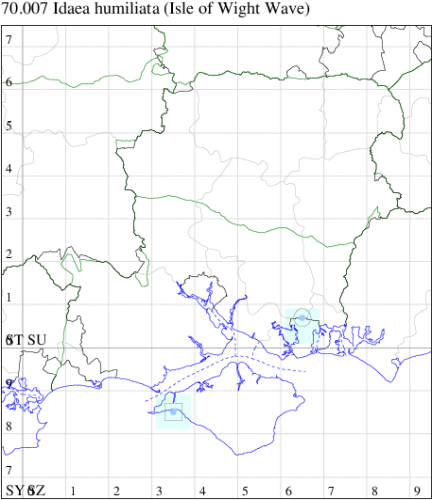
VC10 Isle of Wight
| Site | Date | Quantity | Recorder | Stage |
|---|---|---|---|---|
| Freshwater Bay Down (SZ38) | 1890 | - | Anon | Adult |
| West High Down & Tennyson Down (SSSI) (SZ38) | 1931 | - | Anon | - |
VC11 South Hampshire
| Site | Date | Quantity | Recorder | Stage |
|---|---|---|---|---|
| Cosham (SU60) | 1954 | one | Roger Hayward | Adult |